%20%20--%3E%0A%3Csvg%20version%3D%221.1%22%20xmlns%3D%22http%3A%2F%2Fwww.w3.org%2F2000%2Fsvg%22%20xmlns%3Axlink%3D%22http%3A%2F%2Fwww.w3.org%2F1999%2Fxlink%22%20x%3D%220px%22%20y%3D%220px%22%0A%09%20viewBox%3D%220%200%20887.6%20200%22%20style%3D%22enable-background%3Anew%200%200%20887.6%20200%3B%22%20xml%3Aspace%3D%22preserve%22%3E%0A%3Cstyle%20type%3D%22text%2Fcss%22%3E%0A%09.st0%7Bfill%3A%23145840%3B%7D%0A%09.st1%7Bfill%3A%23FFFFFF%3B%7D%0A%3C%2Fstyle%3E%0A%3Cg%20id%3D%22Template%22%3E%0A%09%3Cg%3E%0A%09%09%3Cpath%20class%3D%22st1%22%20d%3D%22M28.2%2C109h12.2v14.1c0%2C10.5-6.1%2C19.9-20.1%2C19.9c-14.6%2C0-20.3-9.3-20.3-20V78.6h12.9v13.4h27.5v9.3H12.9v20.4%0A%09%09%09c0%2C6.3%2C2.2%2C9.9%2C7.6%2C9.9c5.3%2C0%2C7.7-3.5%2C7.7-9.7V109z%22%2F%3E%0A%09%09%3Cpath%20class%3D%22st1%22%20d%3D%22M77%2C141.8V111c0-7.5-2.5-9.8-8.5-9.8c-6.6%2C0-10.2%2C5.5-10.2%2C12.1v28.5H45.2V73.9h13.1v24.7%0A%09%09%09c1.9-4.4%2C8-7.8%2C14.7-7.8c10.2%2C0%2C17.3%2C6%2C17.3%2C15.9v35.2H77z%22%2F%3E%0A%09%09%3Cpath%20class%3D%22st1%22%20d%3D%22M107.5%2C120.4c0.4%2C7.5%2C4.6%2C12.3%2C11.1%2C12.3c4.2%2C0%2C8-2.1%2C8.9-5.6h13.5c-3%2C10.2-11.2%2C16-21.8%2C16%0A%09%09%09c-16.6%2C0-24.9-9.1-24.9-27.1c0-15.4%2C8.8-25.3%2C24-25.3s23.3%2C9.9%2C23.3%2C29.6H107.5z%20M128.2%2C112.1c-0.2-7.4-5.1-10.9-10.2-10.9%0A%09%09%09c-5.3%2C0-9.6%2C4-10.1%2C10.9H128.2z%22%2F%3E%0A%09%3C%2Fg%3E%0A%09%3Cpath%20class%3D%22st1%22%20d%3D%22M170.5%2C48.3h27.2v108.9c0%2C24.7-17.4%2C41.5-40.2%2C41.5c-28%2C0-41.1-16.4-41.1-42.7h25.3c0%2C11.6%2C3.7%2C18.9%2C14.3%2C18.9%0A%09%09c10.8%2C0%2C14.5-7.1%2C14.5-18.7V48.3z%20M170.5%2C36.1V11h27.2v25.1H170.5z%22%2F%3E%0A%09%3Cpath%20class%3D%22st1%22%20d%3D%22M233.2%2C106.4c0.8%2C15.3%2C9.5%2C25.3%2C22.8%2C25.3c8.7%2C0%2C16.4-4.4%2C18.2-11.4H302c-6.2%2C20.9-23%2C32.8-44.8%2C32.8%0A%09%09c-34%2C0-51-18.7-51-55.6c0-31.5%2C18-51.8%2C49.3-51.8c31.3%2C0%2C47.9%2C20.3%2C47.9%2C60.8H233.2z%20M275.7%2C89.4C275.3%2C74.2%2C265.3%2C67%2C254.7%2C67%0A%09%09c-10.8%2C0-19.7%2C8.3-20.7%2C22.4H275.7z%22%2F%3E%0A%09%3Cpath%20class%3D%22st1%22%20d%3D%22M369.6%2C83.2h25.1v29c0%2C21.6-12.4%2C40.9-41.3%2C40.9c-29.9%2C0-41.7-19.1-41.7-41.1V20.7h26.5v27.6h56.4v19.1h-56.4%0A%09%09v41.9c0%2C12.9%2C4.6%2C20.3%2C15.6%2C20.3c10.8%2C0%2C15.8-7.3%2C15.8-19.9V83.2z%22%2F%3E%0A%09%3Cpath%20class%3D%22st1%22%20d%3D%22M433.1%2C200V49.7H459l0.2%2C12.4c6.4-10.4%2C16-15.1%2C28.4-15.1c25.7%2C0%2C44.2%2C20.3%2C44.2%2C54.7%0A%09%09c0%2C30.9-15.6%2C52.7-41.9%2C52.7c-12.6%2C0-22.6-5.2-30.3-16V200H433.1z%20M504.5%2C99.8c0-18.2-9.5-30.9-23-30.9c-12.9%2C0-22.8%2C12-22.8%2C29.2%0A%09%09c0%2C22.2%2C7.7%2C33.2%2C22.6%2C33.2C497%2C131.4%2C504.5%2C120.8%2C504.5%2C99.8z%22%2F%3E%0A%09%3Cpath%20class%3D%22st1%22%20d%3D%22M537.3%2C151.7v-102h25.3v12.2c8.9-13.7%2C19.3-14.9%2C30.3-14.9h3.5v27.6c-2.5-0.4-5-0.6-7.5-0.6%0A%09%09c-16.6%2C0-24.7%2C8.3-24.7%2C24.7v53.1H537.3z%22%2F%3E%0A%09%3Cpath%20class%3D%22st1%22%20d%3D%22M621.9%2C107.7c0.8%2C15.3%2C9.5%2C25.3%2C22.8%2C25.3c8.7%2C0%2C16.4-4.4%2C18.2-11.4h27.8c-6.2%2C20.9-23%2C32.8-44.8%2C32.8%0A%09%09c-34%2C0-51-18.7-51-55.6c0-31.5%2C18-51.8%2C49.4-51.8c31.3%2C0%2C47.9%2C20.3%2C47.9%2C60.8H621.9z%20M664.5%2C90.7c-0.4-15.1-10.4-22.4-20.9-22.4%0A%09%09c-10.8%2C0-19.7%2C8.3-20.7%2C22.4H664.5z%22%2F%3E%0A%09%3Cpath%20class%3D%22st1%22%20d%3D%22M761.9%2C80.6c-1.2-9.3-6.6-13.5-18.2-13.5c-11%2C0-16.8%2C2.3-16.8%2C8.7c0%2C5.6%2C5.8%2C8.5%2C16.6%2C11.4%0A%09%09c35.7%2C9.7%2C47.3%2C11.6%2C47.3%2C35.5c0%2C18.2-15.6%2C31.7-45.2%2C31.7c-29.2%2C0-48.1-13.9-48.5-35.5h27.8c0%2C9.5%2C8.5%2C15.1%2C20.5%2C15.1%0A%09%09c10.2%2C0%2C18.7-3.1%2C18.7-9.7c0-7.5-5.4-10-16.4-12.4c-39.6-8.7-46.9-18.9-46.9-36.1c0-15.3%2C11.8-28.8%2C43.8-28.8%0A%09%09c29.2%2C0%2C42.1%2C12.6%2C43.3%2C33.6H761.9z%22%2F%3E%0A%09%3Cpath%20class%3D%22st1%22%20d%3D%22M858.8%2C80.6c-1.2-9.3-6.6-13.5-18.2-13.5c-11%2C0-16.8%2C2.3-16.8%2C8.7c0%2C5.6%2C5.8%2C8.5%2C16.6%2C11.4%0A%09%09c35.7%2C9.7%2C47.3%2C11.6%2C47.3%2C35.5c0%2C18.2-15.6%2C31.7-45.2%2C31.7c-29.2%2C0-48.1-13.9-48.5-35.5h27.8c0%2C9.5%2C8.5%2C15.1%2C20.5%2C15.1%0A%09%09c10.2%2C0%2C18.7-3.1%2C18.7-9.7c0-7.5-5.4-10-16.4-12.4c-39.6-8.7-46.9-18.9-46.9-36.1c0-15.3%2C11.8-28.8%2C43.8-28.8%0A%09%09c29.2%2C0%2C42.1%2C12.6%2C43.3%2C33.6H858.8z%22%2F%3E%0A%3C%2Fg%3E%0A%3Cg%20id%3D%22Layer_2%22%3E%0A%3C%2Fg%3E%0A%3C%2Fsvg%3E%0A)

It's that time of year again. The NFL Draft, otherwise known as the NY Jets' annual Super Bowl, returns in just a handful of weeks. Every year, this is an adventure (an important one) within the walls of the $75 million Florham Park headquarters.
But this season is more important than most years. This season, the Jets might need their future franchise quarterback. This is a position the Jets have found themselves in every three to five years since Joe Namath left Broadway for Hollywood in 1977.
It's unclear if the Jets are sure to take a QB. What is clear is that they'll need one soon. And it appears likely they'll opt for one in this draft. So I'll be releasing a series of pieces evaluating the Jets' best options at that position.
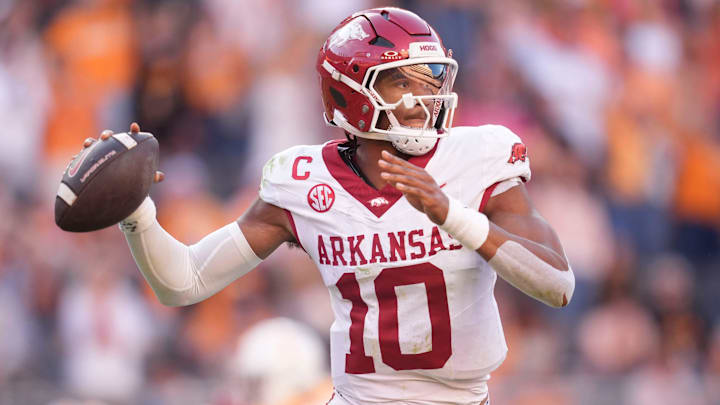
In this piece, we'll focus on probably the most fun – and most confusing – QB I've evaluated throughout this process. You probably haven't heard of him yet, unless you spent your Saturdays watching Arkansas football in 2025. But if this young quarterback meets his full potential, you'll know his name very well, very soon.
On this page:
- Taylen Green's Background
- Taylen Green's Pros
- Taylen Green's Cons
- QB Value Score
- Taylen Green Evaluation and Grade
Taylen Green's Background
A Lewisville, Texas product, Taylen Green, is seen as an electrifying talent with considerable room to improve. He's fast – really fast. He has great raw arm talent. And his ability on RPOs makes him a great fit for a modern offense. He's also a specimen of an athlete, standing at an impressive 6-foot-6, weighing 230 pounds, and running a 4.36 40-yard dash.
But he has a reputation as a guy with a lot of holes. His arm talent hasn't always resulted in world-class accuracy. And decision-making is not exactly his bread and butter yet. For all those reasons, he's seen as someone with good upside but significant downside.
He began his collegiate journey at Boise State, where he started in 26 total games over three seasons, tossing 25 touchdowns to 15 interceptions, averaging 1,897 passing yards per season. But he tacked on 19 rushing touchdowns and an average of 512 rushing yards per season as well. That's what made him so tantalizing: his versatility.
He left the "Smurf Turf" for Arkansas in 2024, where he would remain for his final two seasons. He ran for 16 touchdowns on 1,817 yards and threw 34 touchdown passes on 5,868 yards. He also mixed in a troubling 20 interceptions, something that speaks to why he's a polarizing prospect.
With so many positives and an equal amount of negatives, let's dive into Taylen Green's overall skill set and ultimate potential in the NFL.
Taylen Green's Pros
1. Running talent
Green is not only a fast runner but also a unique one. When you watch Kyler Murray run, his short legs seem to move a mile a second. When you watch Taylen Green run, it doesn't look like his legs are digging rapidly into the dirt. But the ground he covers in each stride is vast, making his speed not only a sight to behold but also deceptive.
The totals are unimpeachable. In his first season at Arkansas, he ran for 823 yards on 129 attempts for eight rushing touchdowns. This past season, he rushed for 994 yards on 113 attempts, again for eight touchdowns. He received an 81.2 Pro Football Focus (PFF) rushing grade in 2024, followed by a 92.2 in 2025.
Tackling him is no small task. Last year, he rushed for 516 yards after contact, including 29 missed tackles forced after a rush. He had 41 explosive runs (rushes over 10 yards), including a 64-yard trot. He finished the year with a 25.6% breakaway percentage and received a 60.1 PFF elusivity rating, which dwarfs any other QB I evaluated.
Of his 242 career rushes at Arkansas, 141 were designed runs. He maintained just about a 58% designed run/scramble ratio throughout both seasons. In 2024, 50.3% of his rushing yards came from scrambles, to 49.7% on designed runs. He flipped this ratio on its head in 2025, with only 46.3% of his yards on scrambles to 53.7% on designed runs. This tells me he's learning as a runner. He's not just reacting to broken plays. He's proactively attacking his opponents with his legs, and it's working.
He's really good at faking the handoff, creating lanes for himself before he even takes off. Despite his long strides, he's shifty once he's in the middle of the field with linebackers and safeties around him. He changes direction quickly, and once you lose your angle as a defender, you lose Green entirely.
His legs will also allow him time to develop. When all else fails, he has a "break glass in case of emergency" skill set in his back pocket, ready to be deployed at any time.
2. Keeps plays alive
After diving so deeply into his running, it should be obvious that he has a keen ability to extend plays that were otherwise fatal. His legs don't just allow him elite agility, but they also allow him to move up and down the pocket with cat-like reflexes.
His legs aren't perfect. One of his biggest flaws, which we'll get to, is his footwork on throws. But his footwork when dodging linemen and blitzers to either find a safe space in the pocket or to bail entirely is excellent. This is coupled with his instincts, which he doesn't get enough credit for. For the most part, he doesn't jump out of position too early. But he never allows himself to be a sitting duck either.
While you can question his decision-making and mechanics as a passer, it's clear to me that he always understands what's going on around him. His instincts in the pocket are there. He just has to keep developing his response to what's going on around him, as a thrower. But he already knows exactly how to respond with his legs.
He knows how to avoid pressure, and the numbers bear it out. His 19% pressure-to-sack rate was about the same as Carson Beck's 18.3%, on far more pressures, with 142 to Beck's 89. It's also identical to Garrett Nussmeier's, while Nussmeier faced only 79 pressures.
It's always been beneficial to have the ability to elongate plays. But in 2026, it's more valuable than ever. With defenders getting bigger and faster, quarterbacks cannot be completely landlocked in one spot. This will never be an issue for Green.
3. Underrated arm strength and accuracy
No one really talks about Green's arm, and this isn't for no reason. His passing, while far from negative, is not what sets him apart from his peers.
That said, there is a reason he was a power-five quarterback who's about to get drafted, and not a skill-position player. He has an absolute cannon for an arm. And he can make throws to all levels of the field. He can throw with touch on deep balls and velocity in between the numbers.
The reason he's not known for his passing is that he's still inconsistent in his decision-making. But I would also argue that if he were used more effectively, his efficiency would drastically increase.
He's a great thrower on the run and reads the defense well while moving. He's also such a great dual-threat that you'd assume he'd be used in a lot of play action and rollouts. But only 19.3% of his snaps came in the play action last year, the least of any quarterback I evaluated.
It's not as though his metrics shrink on those plays either. He maintains a 63.9 passing grade, aligned with his 65.6 overall passing grade, and he maintains a 71.4% adjusted completion percentage, almost identical to his 71.3% overall. His pressure-to-sack rate improves massively from 19% to 6.7%, and his NFL passer rating jumps from 91.9 to 121.7 on those plays.
When he's in the right position, he can throw the pigskin with anyone.
4. Soft skills
I've never met the kid. And this is a completely objective metric. But when you watch play after play after play from these guys, you see how they react to success. You see their level of arrogance when they make a big individual throw or run. You see how their personality commands the offense. You see how their teammates react when they succeed.
Green checks all the boxes here. While soft (and well) spoken off the field, he is a dawg on it. He's as arrogant as it gets, dancing after big runs and running his mouth as he sprints downfield after touchdown passes. His teammates are all over him when he scores, and the entire offense gravitates in the direction he dictates.
He's a gamer. All you have to do is actually watch him play to see that. And if you ask longtime NFL draft expert Todd McShay of the Ringer, Green is coachable, responding well and fast, to coaching at the Senior Bowl. And if you ask his veteran head coach, Bobby Petrino, he's a self-motivated kid who takes direction well and responds to constructive feedback and new information efficiently.
Whether he succeeds, or fail, it won't be his head that does him in.
Taylen Green's Cons
1. Questionable decision-making
This is a piece of his game that unquestionably needs work. His 11 interceptions, 22 turnover-worthy plays, and 5.3% turnover-worthy play percentage are a massive eyesore. No other QB I evaluated even cleared more than a 3% turnover worthy play percentage.
It doesn't help that he has a long way to go in his ability to read defenses, both pre- and post-snap. He is a bit of a project in that sense.
But a lot of the turnovers, while still the result of poor decision-making, were also a result of his being put in a position to fail. His average depth of target was 9.5 yards, which is massive. No other QB even got to nine yards. And as I stated previously, he wasn't working within an offense that accentuated his strengths as well as it could have.
Sure, the decision-making wasn't great. That absolutely plays a part. A lot of it comes from his trying to be Mr. Do-It-All for the Razorbacks, often thinking he has to be the hero. His high ADOT number speaks to that. With professional coaching, a more Taylen Green-friendly offense, and the understanding that he can't always make a play when a play's not there, you'll see a massive improvement in his decision-making.
2. Footwork & throwing mechanics
I've seen a particular weakness in Green's game described as "late-eyes." This means he gets his eyes downfield more slowly than he should and is slightly off-tempo with receivers on underneath routes as a result. It doesn't help that his footwork is sloppy when dropping back, causing timing issues from the jump.
And while he's excellent at avoiding rushers, his mechanics go completely out the window when he's throwing in the pocket under pressure. His feet stick together, and he ends up pushing the ball out awkwardly, which leads to many of his turnovers and inaccuracy issues.
For all that he has in god-given running ability when defenders triage him, he lacks the ability to move, reset, and fire, once forced off the top of his drop. You see it in plays when he has to reset his feet. He never quite sets, and his ability as a passer plummets.
A lot of people highlight accuracy as a general weakness for Green, but I don't see it that way. I think his accuracy is fine in most contexts. It's one specific context where it goes south, which leads us into his final weakness.
3. Passing ability under pressure
Green finished last year with an 82.5 pass grade and 74.7% adjusted completion percentage when not pressured, and his turnover-worthy play percentage drops from 7.8% when pressured to 3.8% when not. It's clear that his mechanical faults, while being hurried, account for the vast majority of his struggles.
His average depth of target increases on plays when he's under pressure and being blitzed, vs plays where he's not under pressure and not being blitzed. This tells me that he puts on his Superman cape when plays breakdown, and forces the issue deeper than he has to. This is never going to work for him.
He was under pressure more than any quarterback I looked at, with 36.1% of his dropbacks coming under pressure. With a professional offensive line, coaching that tunes his mechanics, and an improved knowledge of when to take risks and when not to take risks, a lot will change for Green.
QB Value Score
I've developed a statistic to score young quarterbacks. I took the statistics and Pro Football Focus (PFF) grades I value most and consolidated them into a single number. There are 13 metrics. From most crucial to least, they are as follows (I'll also include Green's numbers for each metric/grade).
Metric | Statistic | |
|---|---|---|
13 | Passing Grade | 65.6 |
12 | Adjusted Completion % | 71.3 |
11 | Big Time Throw % | 3.2 |
10 | Turnover Worthy Plays % (100 - TWP%) | 5.3 (94.7) |
9 | Pressure to Sack % (100 - P2S%) | 19.0 (81) |
8 | Rush Grade | 92.2 |
7 | Passing Grade when Pressured | 29.5 |
6 | Passing Grade When Blitzed | 64.4 |
5 | Passing Grade on Deep Passes | 80.3 |
4 | Passing Grade on Medium Passes | 90.4 |
3 | Passing Grade on Short Passes | 56.6 |
2 | Average Time to Throw (4- TTT) | 3.20 (0.8) |
1 | Average Depth of Target | 9.5 |
3. Passing Grade on Short Passes: 56.6
All you have to do is multiply each metric by its corresponding number. Then add them and carry your decimal two places to the left. That provides you with your Quarterback Value (QBV). You can typically expect this number to be between 40 and 70.
- QBV: 56.94
Green's grade is dragged down by his issues under pressure. He holds a very low passing grade when pressured, and a relatively low grade when blitzed. His low overall passing grade, along with his turnover-worthy play percentage, are mainly due to his drawbacks when hurried.
Not that it's a good thing that one major trend holds back much of his metrics, but it makes him all the more fixable.
Taylen Green Evaluation and Grade
I rely on a combination of metric-driven analysis, results-based statistics, and the old-fashioned eye test to evaluate quarterbacks. After considering all factors, below is my final prospect grade, along with some pro comparisons ranging from the most realistic scenario to the absolute ceiling.
- FINAL GRADE: C+ prospect. He has a ton to work on, and if he doesn't hone his elite yet raw talent, he'll likely be a career backup similar to Wentz. But if he excels on his upside, I can see him becoming a very solid, extraordinarily exciting starter for years. He looks like Kapernick the way he runs and throws, and I could see him turning into a Trevor Lawrence-style pro.
- NFL Comparisons: Carson Wentz, Vince Young, Daniel Jones, Colin Kaepernick, Trevor Lawrence
This is a kid with talent and physical tools that don't come around often. If he really hits, he could be a homerun. If he doesn't hit, he could be a total strikeout. There's a lot of variance with Green.
This variance makes him a risk. But as high a risk as he might be, he might potentially become an even bigger reward. For that reason, I think it makes sense for the Jets to draft him anywhere during the third round or later. He's a project. But he might turn out to be an incredibly successful one.
 Add us as a preferred source on Google